
AI Chat Copilot




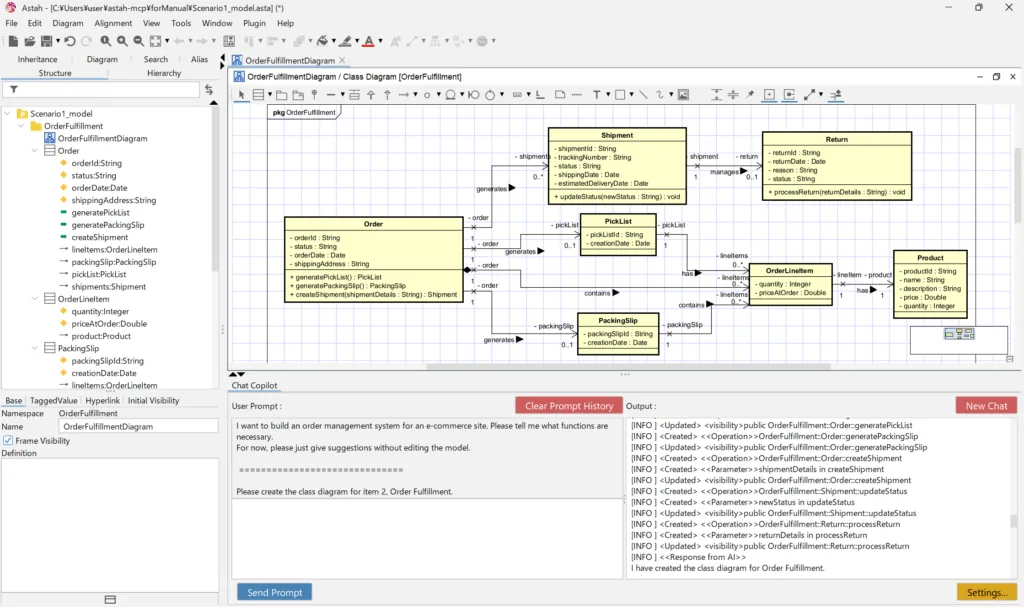
The Astah AI Chat Copilot is an embedded assistant pane that supports your modeling work through natural language conversation—allowing you to generate, interpret, and refine complex architectures without ever leaving the Astah environment.
Overview
Direct In-App Assistance: AI Chat Copilot adds a dedicated Chat pane to your workspace, allowing you to interact with an AI while actively viewing your models and diagrams.
Bring Your Own Model: The Copilot connects securely to an external AI service of your choice. Astah does not perform native AI processing, nor does it store, analyze, or train on your private user data.
API-Driven: A valid API key or endpoint configuration from your preferred provider is required to activate the Copilot features.
Why Use AI with Astah?
- Text-to-Model Conversion: Transform complex text descriptions into structured UML/SysML diagrams instantly.
- Rapid Prototyping: Explore design variations and alternative software architectures in seconds.
- Deep Documentation: Instantly interpret and document legacy or highly complex existing models.
What AI Chat Copilot Can Do
Copilot supports your modeling with three core actions:
1. Generate diagrams from text
Describe a system, feature, or scenario in your own words, and Copilot proposes diagrams.
Supported Diagram types
(Available diagram types depend on your Astah edition):
- Class Diagram
- UseCase Diagram
- Sequence Diagram
- Activity Diagram
- Statemachine Diagram
- ER Diagram
- Block Definition Diagram
- Internal Block Diagram
- Parametric Diagram
- Requirement Diagram (Only on Astah SysML and Astah System Safety)
2. Summarize and interpret existing diagrams
Ask the Copilot to analyze elements active on your canvas to:
- Explain complex system behaviors in plain language.
- Highlight primary execution paths or edge cases in behavioral diagrams.
- Map structural responsibilities and dependencies between objects.
Perfect for design reviews, stakeholder onboarding, and cross-language documentation.
3. Refine, Edit & Expand Architectures
Leverage expanded model retrieval capabilities to iterate on existing designs:
- Improve the structure of your diagrams
- Check for missing elements or inconsistencies
- Request additional details or alternative designs
Copilot helps you iterate quickly, while you keep full control over what is applied to your models.
For more scenarios and prompt examples for design workflows, model analysis, documentation generation, and code integration — see: Detailed Scenarios & Prompt Examples (Currently for Astah Professional and UML only.)
Quick Start
Get up and running with the AI Chat Copilot in four simple steps:
- Create a new or open an existing file
- Access the Chat Copilot pane
Select the Chat Copilot tab in the Extra view which you can open from [View] – [Show/Hide Extra View].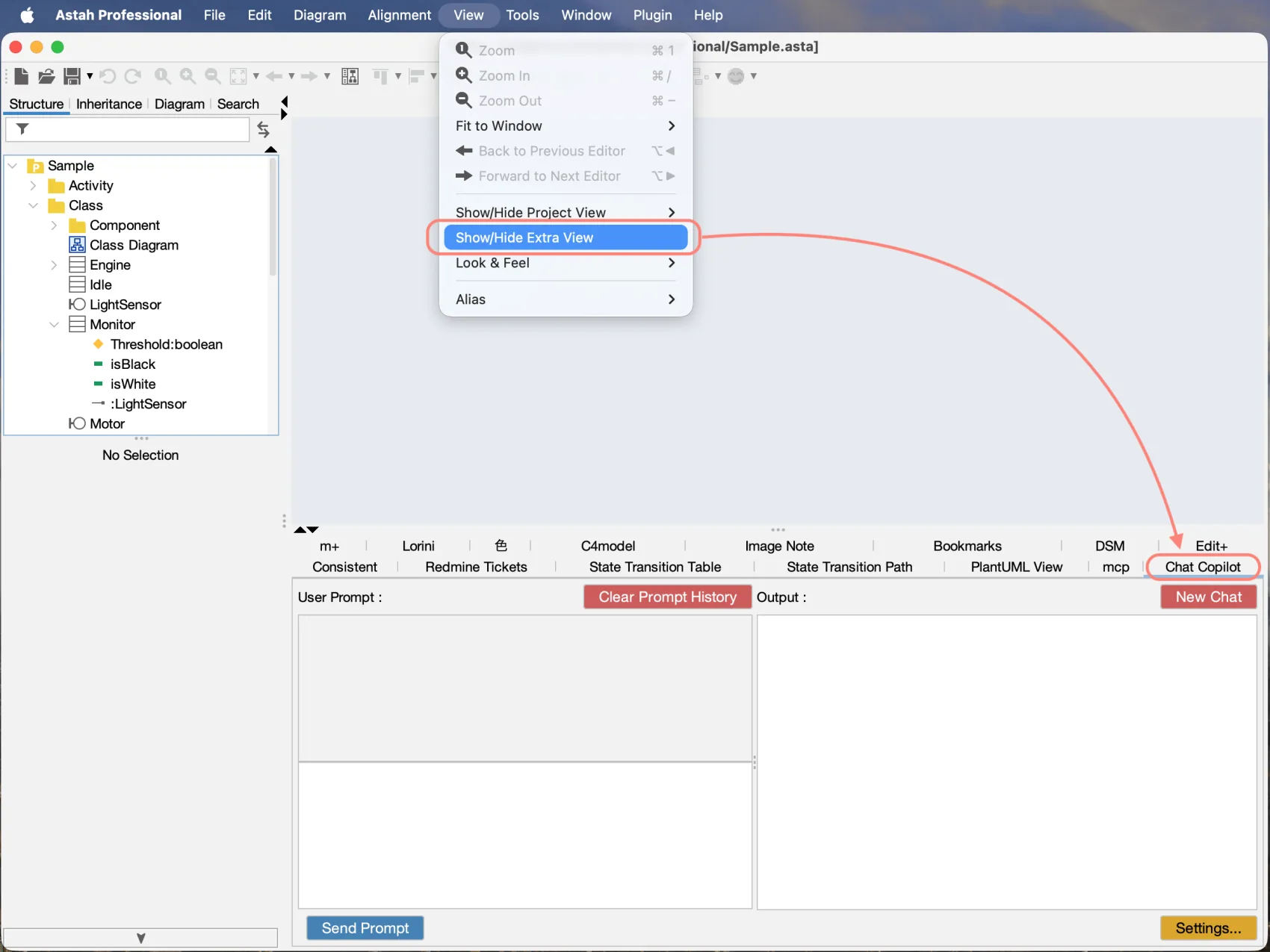
- Settings
Click Settings in the Chat Copilot view and select which AI services and models you want to use, along with other options. For more details, see the Settings section below.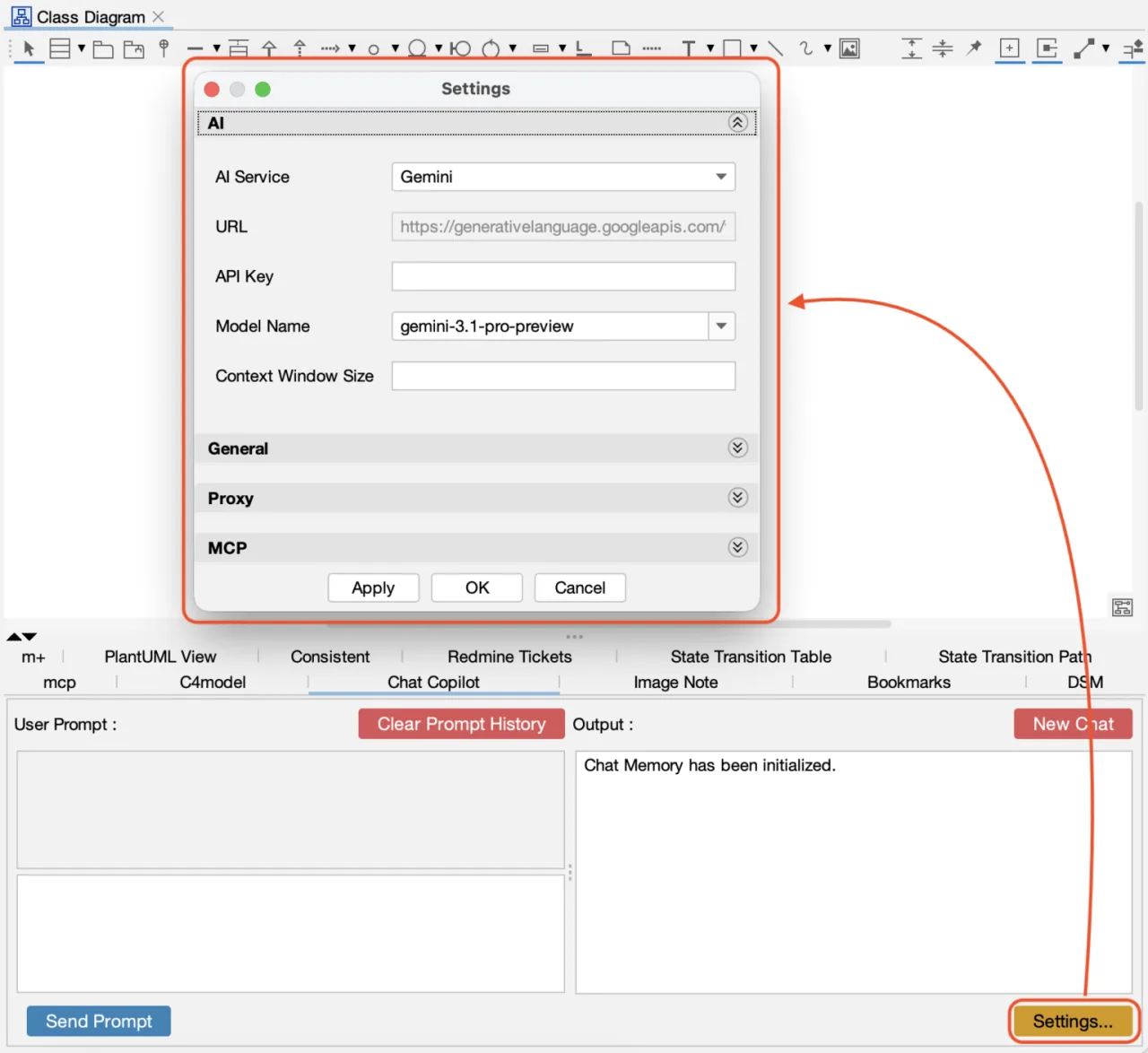
- Prompt & Build:
Type your instructions naturally in the User Prompt area and click Send Prompt. The AI’s structural breakdown will appear in the Output section, and the generated elements will appear on your canvas.
Tip: To wipe the slate clean and clear context history, click New Chat in the upper-right corner.
Settings
Enable and Configure AI Chat Copilot
To use AI Chat Copilot, you need to enable AI features and confirm your connection settings.
Configuration Steps
- Open Settings in the Chat Copilot view, then configure the following sections.
1. AI Settings
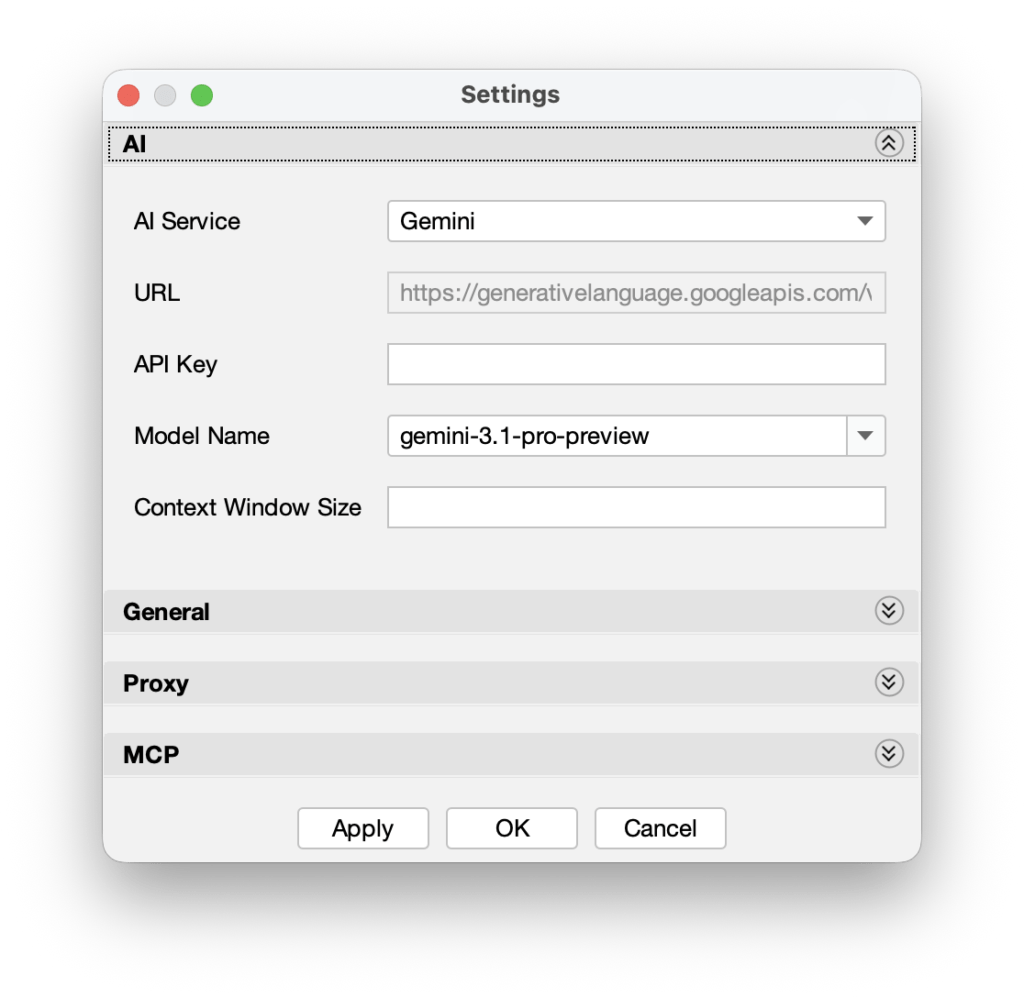
- AI Service: Select your backend provider.
- Supported options: OpenAI / Azure OpenAI / Claude / Gemini / OpenAI-compatible.
- Note:
- Azure OpenAI is exclusively available for Astah Professional and Astah UML (Version 12 and later).
- When selecting Azure OpenAI, input your specific Deployment Name and API Version (leave empty to default to the latest API version).
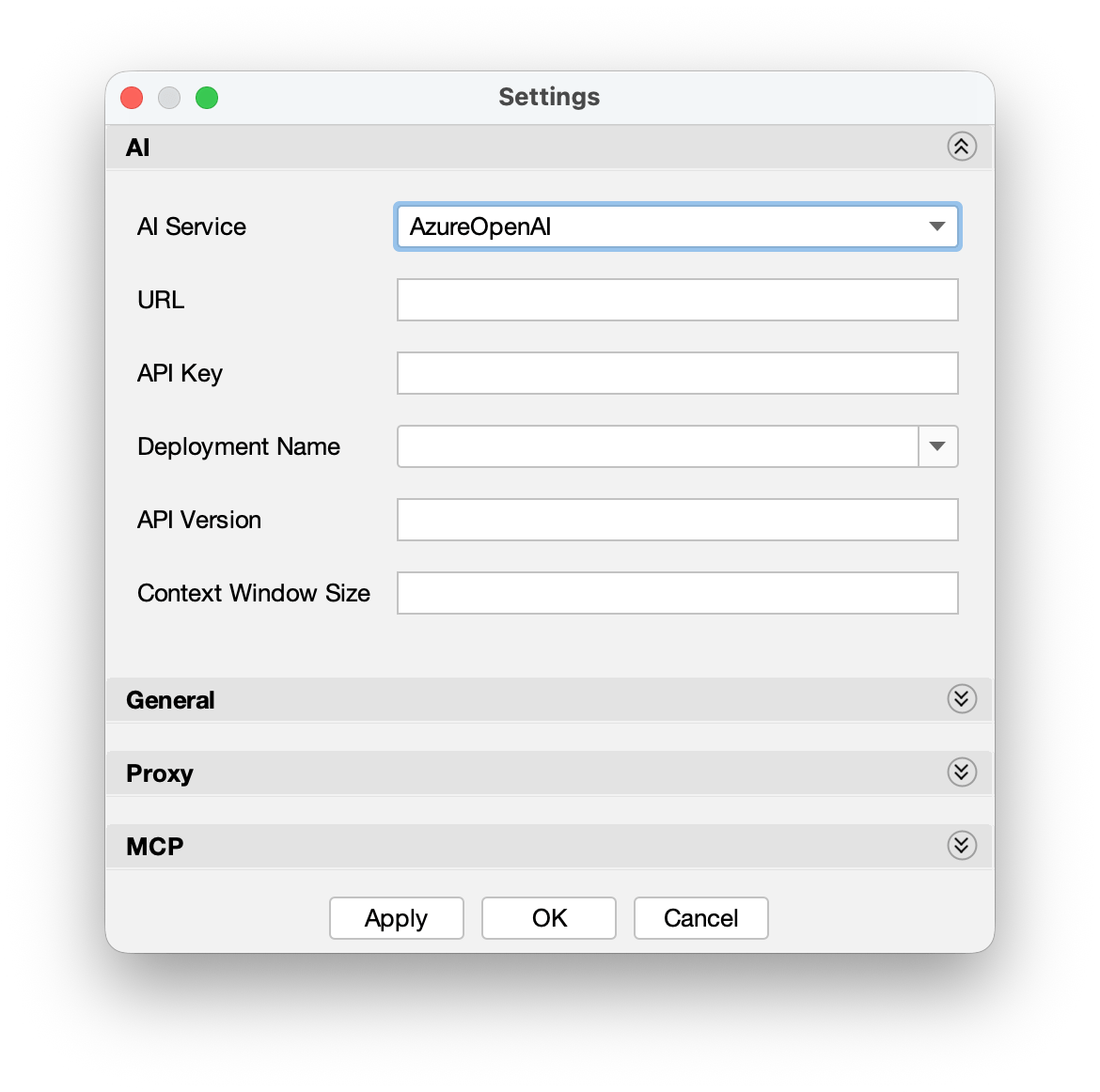
- URL: Specify the base API URL (editable only when OpenAI-compatible or specialized enterprise endpoints are selected).
- API Key: Paste the secure authentication key generated by your provider.
- Model Name: Choose your preferred LLM. After inputting your API key, click [Apply] to dynamically fetch available models. This includes support for next-generation Reasoning AI models (ThoughtSignature).
- Context Window Size: Defines the maximum token memory for the conversation context. Leave blank to let Astah manage this automatically based on the model’s standard limits.
💡 Note on Temperature: Manual temperature/creativity sliders have been removed in Astah Professional and UML Version 12 to streamline your experience. The Copilot now automatically optimizes generation predictability and context awareness out of the box.
2. General
Configure general behavior of AI Chat Copilot.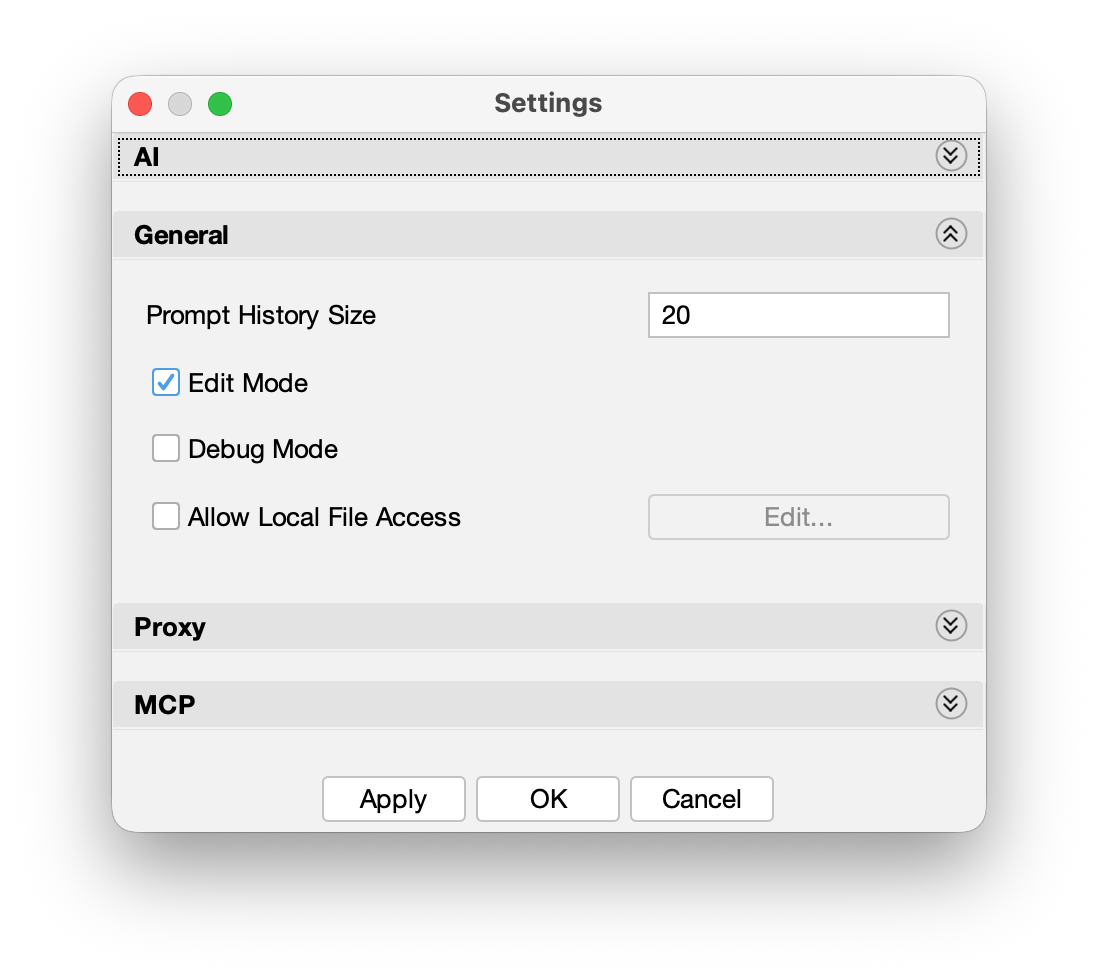
- Prompt History Size: Sets the maximum number of past user inputs retained in the dropdown history (Note: Response text is not saved locally).
- Edit Mode (Enabled by Default): Allows the AI to actively modify, add, and link elements on your canvas. Disable this to restrict the Copilot to “read-only” analysis mode.
- Debug Mode: Generates detailed system logs for troubleshooting connection drops.
Log file location: (User Home)/.astah/professional, uml, sysml or systemsafety/astah-copilot.log - Allow Local File Access: Permits the AI to ingest local text files for context. Click [Edit] to whitelist specific folders. Use caution with proprietary or sensitive directories.
3. Proxy
Configure network connection settings.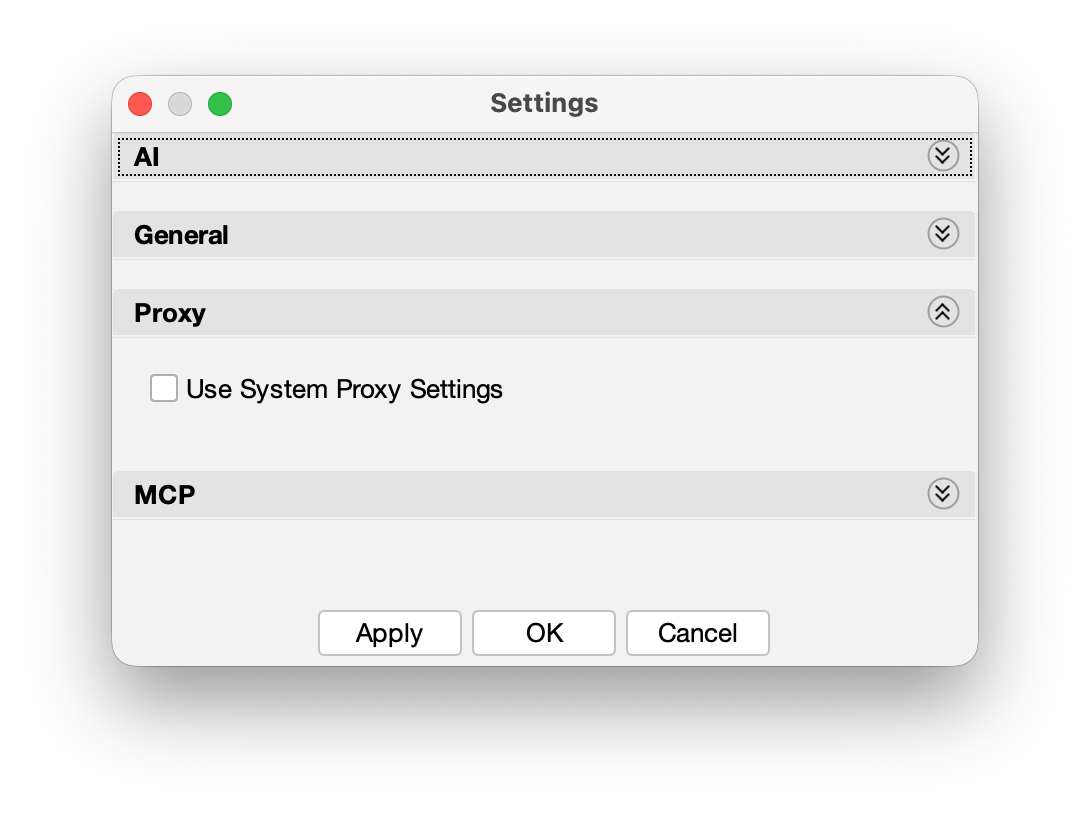
- Use System Proxy Settings: Enable this to connect to the AI service using the system proxy settings.
4. MCP
You do not need to configure the MCP section if you only use AI Chat Copilot inside Astah. Configure it if you want to integrate Astah with external AI clients that support MCP. MCP integration also requires the AI Settings above (AI service and API key).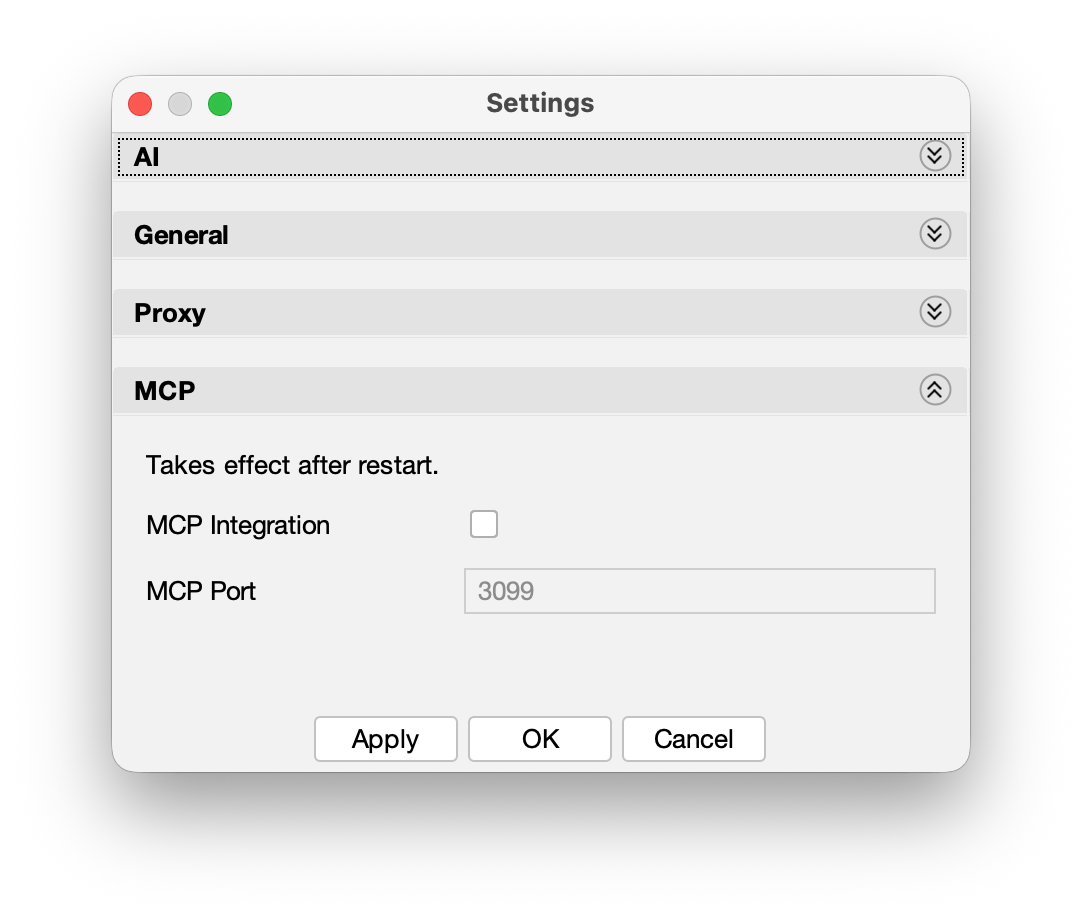
Notes and Limitations
- AI Chat Copilot relies on an external AI service.
- AI-generated results may be incomplete or inaccurate.
- Always review and validate diagrams before use.
- Do not enter confidential or sensitive information unless permitted by your organization’s policies.
Token Limitations
- AI services have an upper limit on the number of tokens they can process.
- Sending or receiving very large specifications or model data in a single request may:
- Reduce response quality
- Cause timeout or errors
- Make processing unstable
- Try to adjust your prompts so that the exchanged information does not become excessively long.
Version & Update Information
AI Chat Copilot is a plugin that comes pre-installed with Astah. It also includes Astah MCP Server, so updating AI Chat Copilot updates the MCP server as well. The list below shows the latest AI Chat Copilot version for each Astah edition and version:
- Astah Professional and UML v12 / Chat Copilot v1.1.0
- Astah System Safety and SysML v11 / Chat Copilot v1.0.0
- Astah Professional and UML v11 / Chat Copilot v1.0.0
How to Update AI Chat Copilot
- Download the appropriate AI Chat Copilot version from the link above.
- Drag and drop the .jar file into the Astah window while Astah is running.
- Restart Astah to apply the update.
How to Check Your Installed AI Chat Copilot Version
- Open [Plugin] → [Installed Plugin].
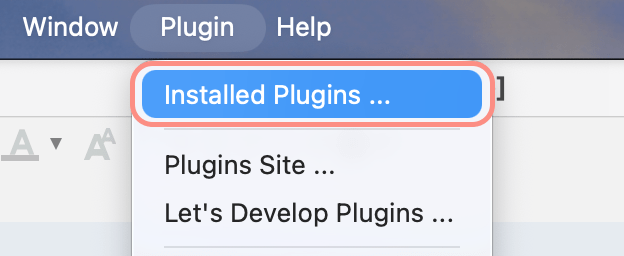
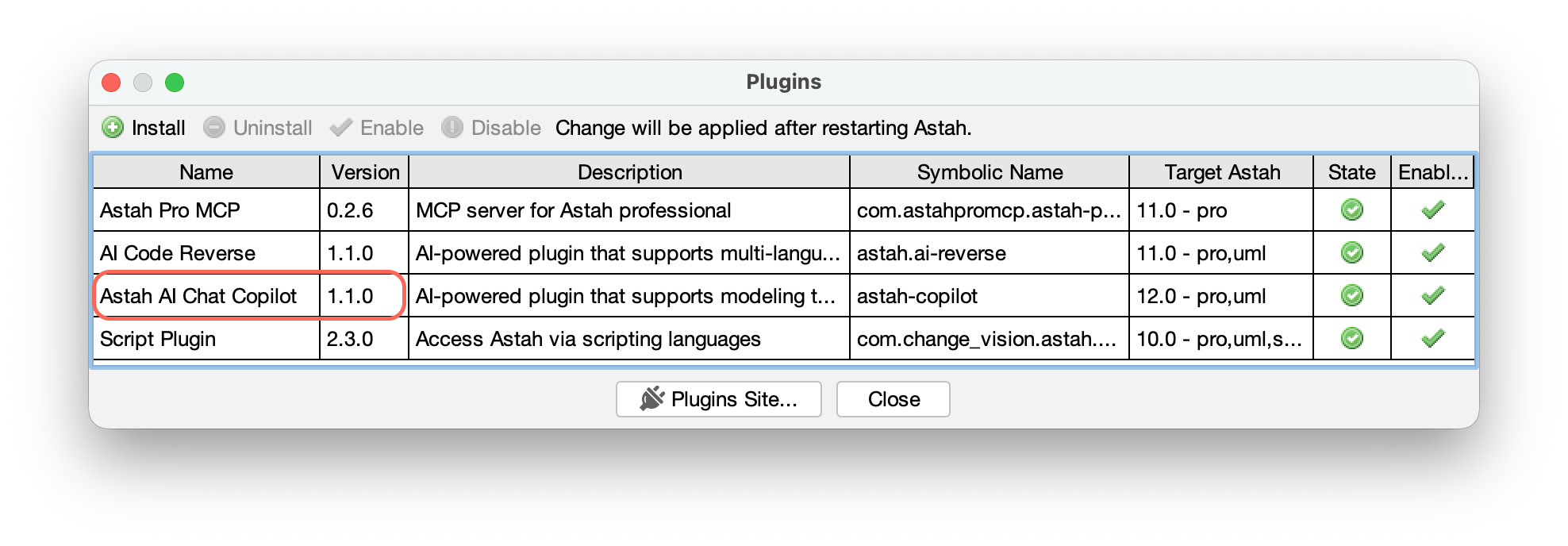
- A list of installed plugins will appear.
- Locate “Astah AI Chat Copilot” and check the Version column.
How to uninstall AI Chat Copilot
- Open [Plugin] → [Installed Plugin].
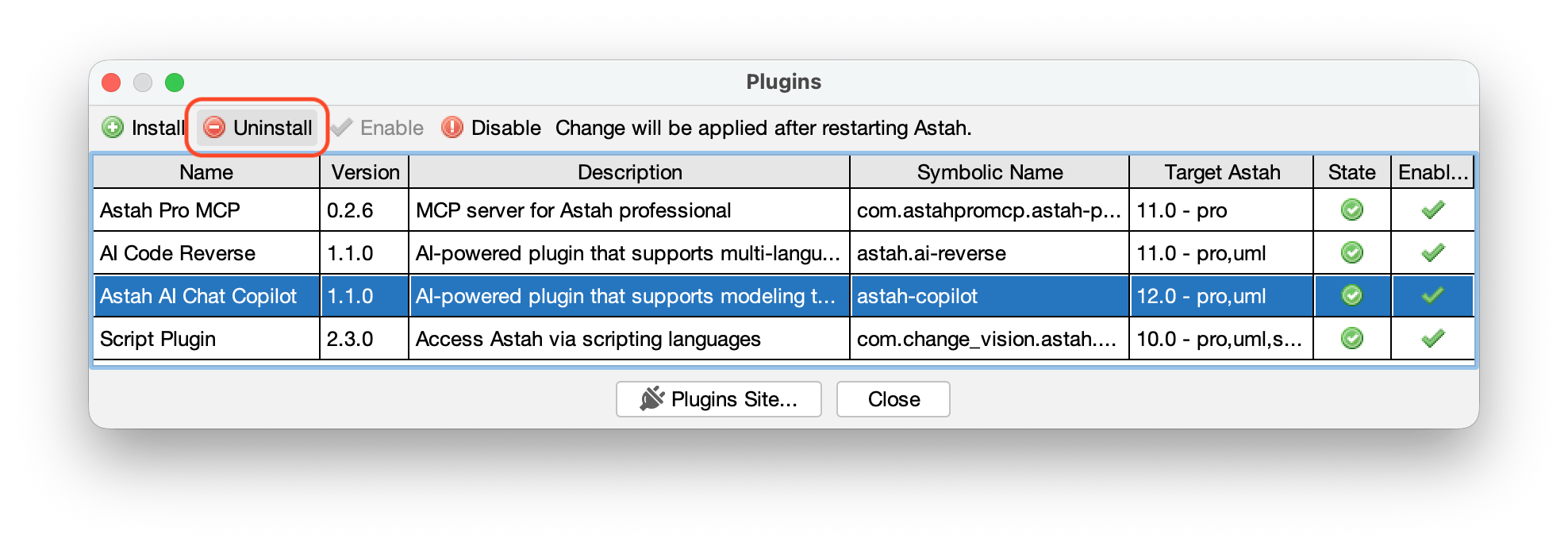
- A list of installed plugins will appear.
- Locate “Astah AI Chat Copilot” and click [Uninstall].
- Restart Astah.
- AI Chat Copilot pane no longer appears.